Where the food
tastes like home
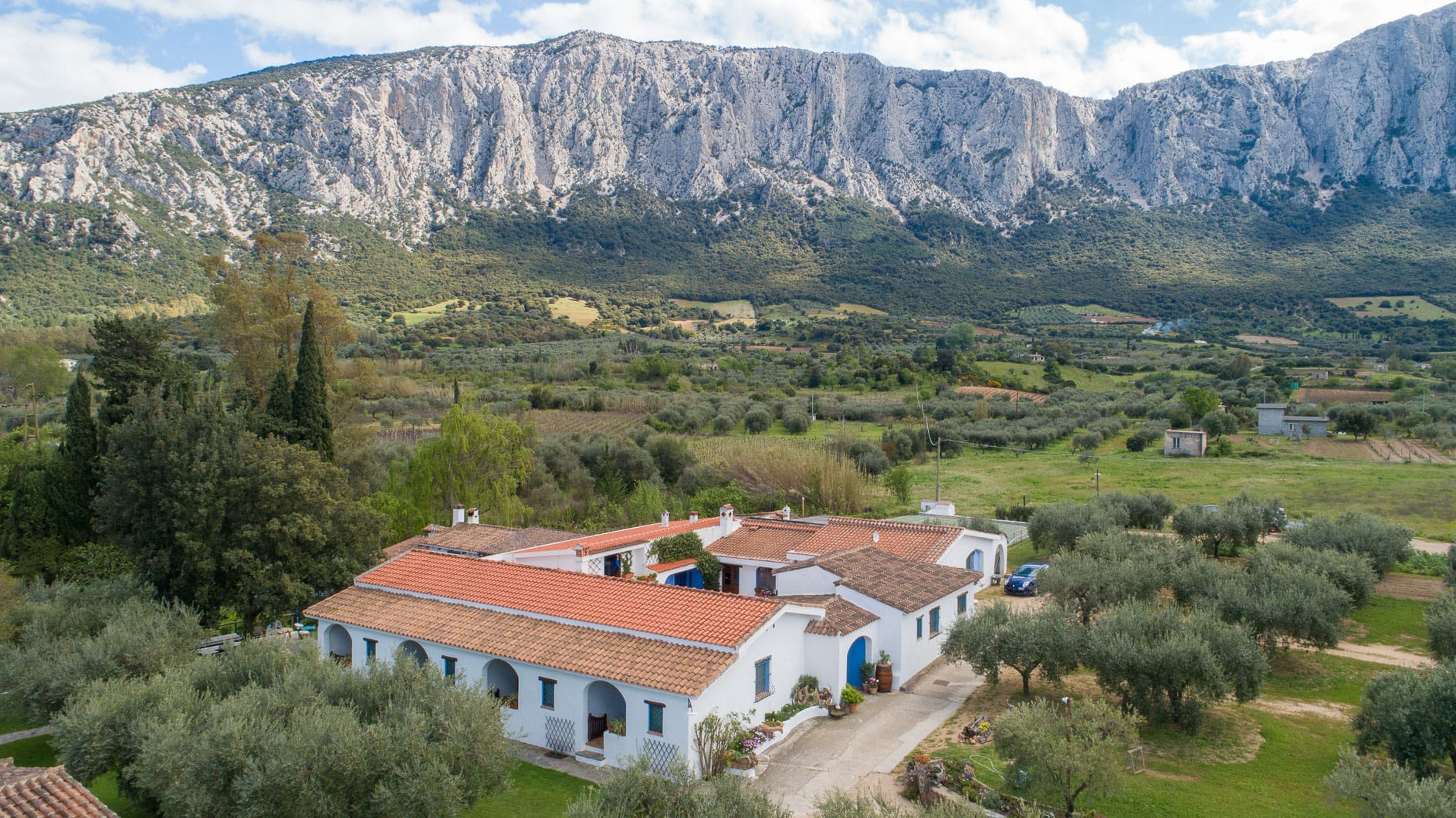
Agriturismo Guthiddai — a family home at the foot of the Supramonte, in the same hands for four generations.
Evening falls slowly over Oliena. The string lights in the garden come on, one by one. In the garden, people from different countries sit at their tables — and yet it feels nothing like a restaurant. On the table: a dark bottle of olive oil, produced here, labelled "Guthiddai". No waiter brings it. Gianluca sets it down himself.
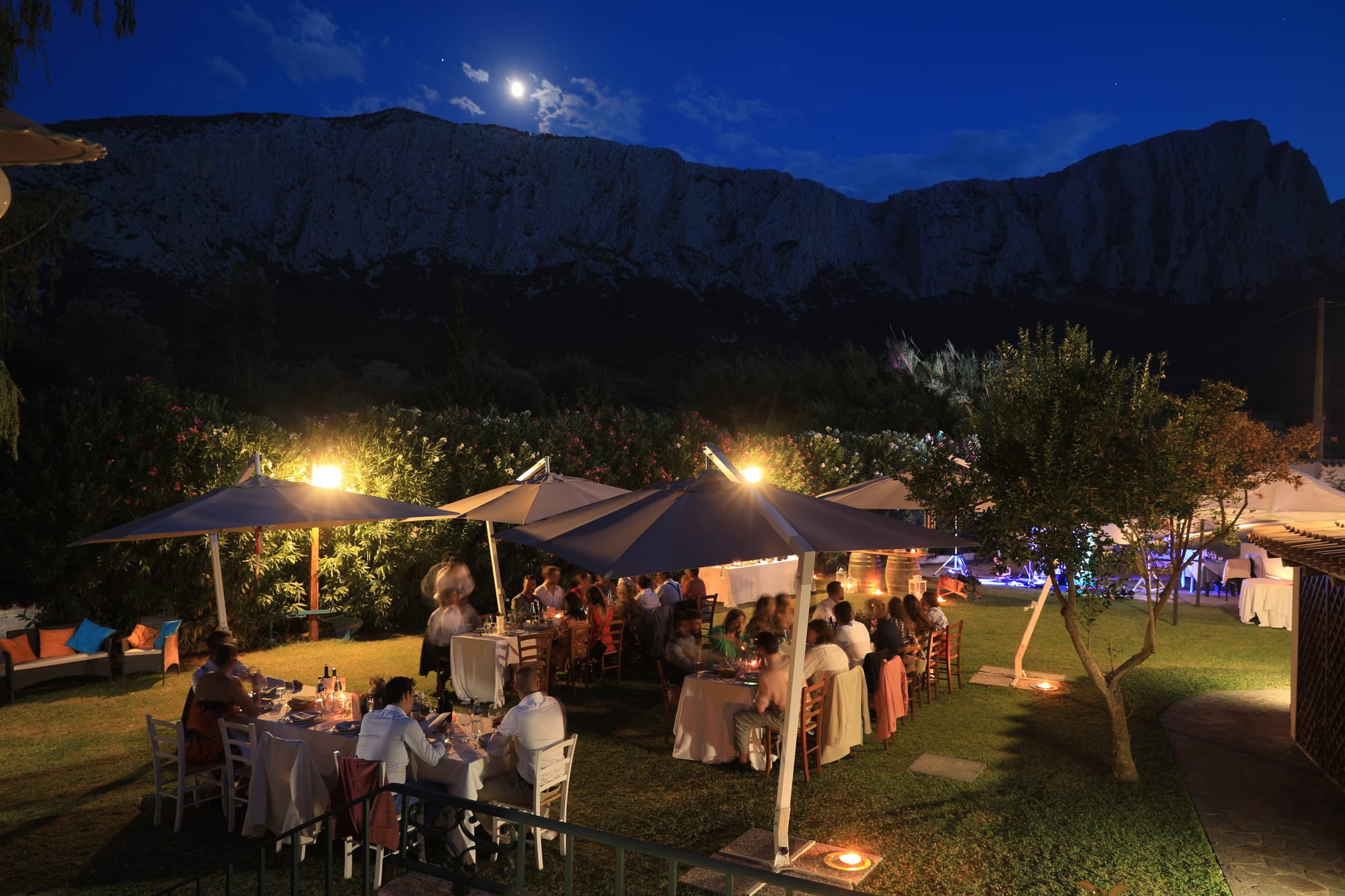
An evening in the garden of Guthiddai — moon over Monte Corrasi, candlelight, oleander. — © Agriturismo Guthiddai
Not a hotel. A family home.
Agriturismo Guthiddai sits at the foot of the Supramonte — precisely where Barbagia stops being a geographical description and starts being a way of life. Since the 1950s, the Floris family has worked this land: vineyards, olive groves, vegetable gardens, livestock. At some point, they decided to open the doors. Not to become a hotel. But to show how life is lived here.
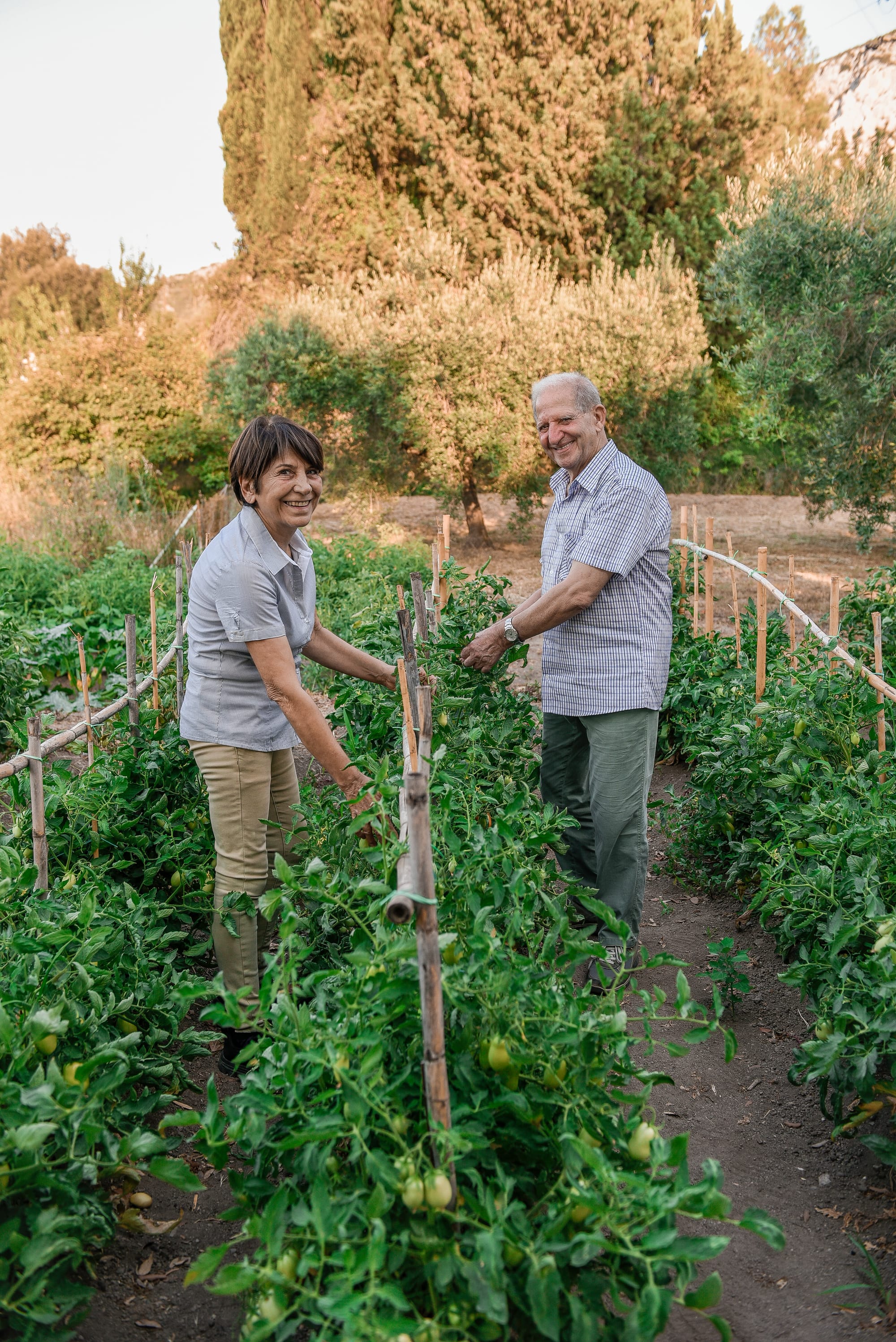
Gianluca and Antonella Floris run the farm, which has been in family hands for four generations. Their parents still help out. The grandmother can be found in the vegetable garden. You don't simply sleep here. For a few days, you become part of this family.
"Guthiddai was never created for tourism. It is a family home that has worked this land for four generations. What moves our guests the most is the simplest thing: feeling how everything connects — the olive oil on the table, the wine in the glass, the vegetables on the plate. This isn't a concept. This is our life."
— Antonella Floris, Agriturismo Guthiddai
Recipes nobody ever wrote down
The menu changes every evening — simply because it depends on what the garden is giving right now, and the garden gives a great deal. Zucchini blossoms in early summer. Fava beans with milk and mint. Tomatoes still warm from the sun when they reach the plate.
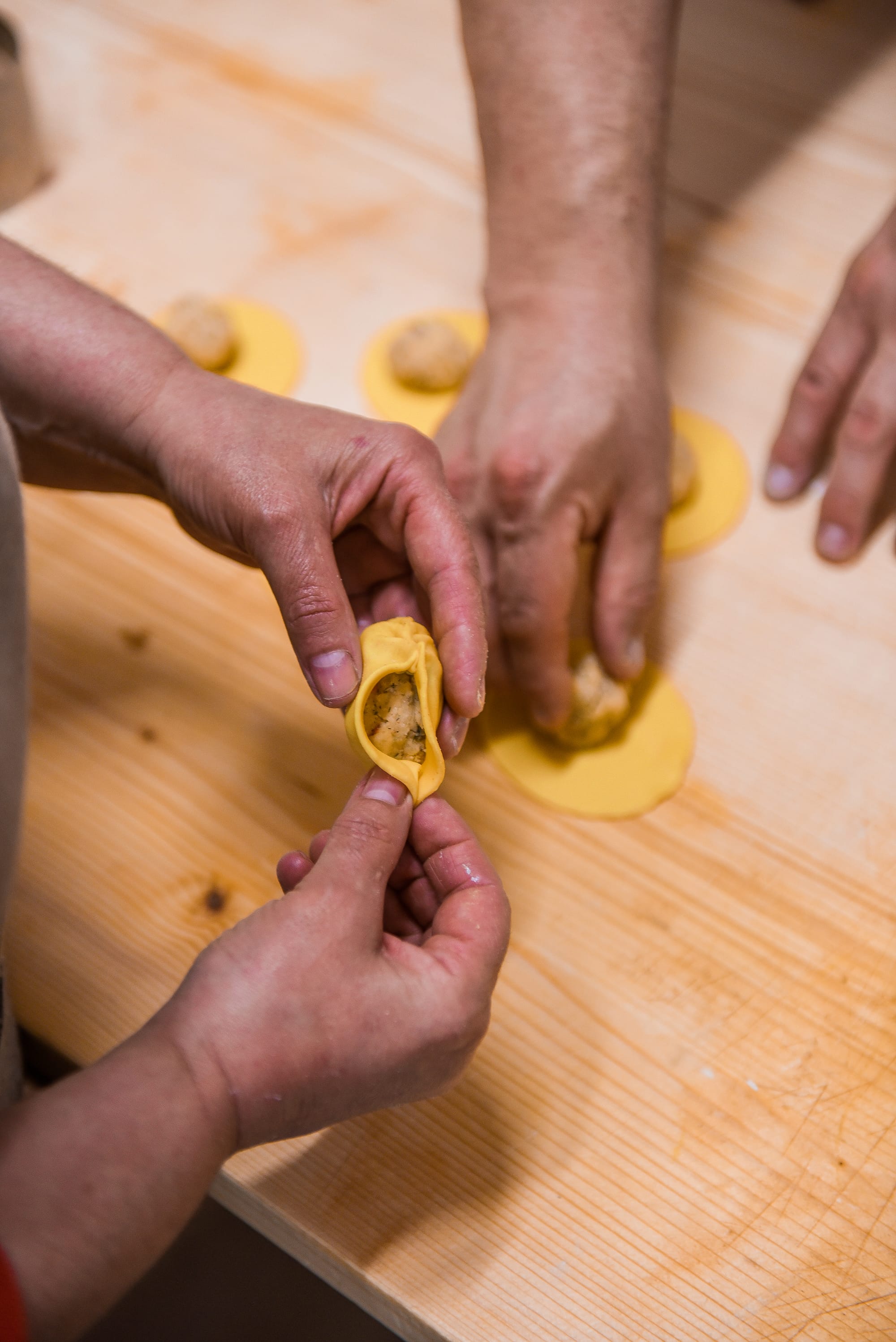
Ravioli with Pecorino from their own production · The vineyards of Guthiddai — where the Cannonau "Mannoi" is born. — © Agriturismo Guthiddai
The culurgiones — Sardinia's signature stuffed pasta — are shaped by hand, filled with potato, mint and pecorino from the farm. The Cannonau — Sardinia's most celebrated red grape variety — grows in their own vineyard and is bottled as "Mannoi", named after the family's grandfather. The olive oil on the table carries the Guthiddai label. You taste how much heart has gone into these products — and something of the long history behind them.
A life that needs no explanation
Ogliastra and the Barbagia are among the five longevity regions in the world — the so-called Blue Zones. Sardinia has the highest concentration of centenarians per capita in Europe. Researchers point to the reasons: daily movement outdoors, strong family ties, a life attuned to the rhythms of nature.
"The Blue Zone isn't just about food. It's a way of life: working outside, strong family bonds, respect for nature's rhythm. Our guests feel this without us having to explain it."
— Antonella Floris, Agriturismo Guthiddai
At Guthiddai, you experience Sardinia as it has always lived — in harmony with nature. You feel it.
Practical info — Agriturismo Guthiddai
Address
Località Guthiddai
08025 Oliena (NU)
Sardinia, Italy
Website
agriturismoguthiddai.it
Rooms & Prices
Rooms with private bathroom
Prices on request
Dinner approx. €40 / person*
Booking
Direct or via Booking.com
Rating 8.8 / 10
Activities
Shepherd's walk (Sos Pinnettus)
Cooking classes
Cannonau wine tasting
Getting there
Cagliari Airport (CAG) approx. 1.5 hrs
Olbia Airport (OLB) approx. 1.5 hrs
Car hire essential
Best time to visit
April–June
September–October
* Please confirm prices directly with the agriturismo.
Agriturismo Guthiddai is not a hotel. That's exactly the difference.
You don't simply sleep there. For a few days, you become part of this family — eating what the garden is giving right now, drinking wine planted by grandparents, sitting in the garden under string lights while Monte Corrasi emerges in the moonlight.
This is the opposite of what Sardinia usually shows us. No turquoise water. No luxury yacht. Instead: the scent of fresh basil, old recipes passed down through generations. And the quiet feeling that you've found something most tourists will never see.
This is why this region is a Blue Zone. Because of a way of living.
— Claudia, curator
Alone on
the river
Kayaking the Cedrino — Sardinia from the water, between limestone walls and a spring no one has ever fully explored.
The others pull up to shore to climb the little church of San Leonardo. Nicole Raukamp stays in the kayak. Picks up the paddle once more and continues upstream — towards Su Gologone.
"It felt as if I were the only person in the world. As if all the things going wrong on this planet simply didn't exist for a small moment. That peace and that freedom are hard to find anywhere else."
— Nicole Raukamp, pecora-nera.eu
A river nobody has fully mapped
Lago del Cedrino lies about 20 km from Guthiddai — a reservoir from which the Cedrino river winds its way through the Supramonte all the way to the Su Gologone spring. That karst spring which has never been fully explored, and which Sardinian tradition holds to be inexhaustible.
Those who hire a kayak paddle one of Sardinia's most unspoilt waterways: past limestone walls, through the deep greens of the Supramonte, past places that are completely untouched.
"The many dense shades of green, the water almost fluorescent, the walls in dark green on grey stone — it had an incredibly calming, sheltering effect. The nature between those mountain walls is simply breathtaking."
— Nicole Raukamp, pecora-nera.eu

View from the kayak — the waters of the Cedrino, the rocks of the Supramonte. — © Nicole Raukamp / pecora-nera.eu
Sun, water, silence
On clear days you paddle in full sun the entire time. Bring water — at least two litres. Sunscreen and a hat are not suggestions, they're essentials. Weather in the Supramonte can turn quickly.
From here, the Gola del Gorroppu is also reachable — one of Europe's deepest gorges, with walls up to 500 metres high. Accessible on foot only; no bus can reach it.
Practical info — Kayaking the Cedrino
Starting point
Lago del Cedrino
approx. 20 km from Guthiddai / Oliena
Duration
Half day to full day
depending on route
Difficulty
Easy — no prior experience needed
Bring
2+ litres of water · sunscreen
hat · light rain jacket
Combination
Approx. 30 min drive from Guthiddai
Ideal as a half-day trip
The Cedrino touches you in a particular way — through its silence and the towering stone walls that close in on either side.
Reading Nicole's description — that moment alone on the river, the others on the shore, paddle in hand, nothing but water and rock — I understand why you don't need to go to the beach to find Sardinia's soul.
The interior has its own way of getting hold of you.
— Claudia, curator
Walking with
the sheep
The Tràmuda — a day with real shepherds on one of Europe's oldest routes. UNESCO Intangible Cultural Heritage. Still very much alive.
A whistle. Nothing more.
A short, sharp sound — and the sheep that had just wandered down a side street in Arzana turn around. No argument. No second whistle. As if they've known for generations what that sound means.
The shepherd shrugs. I didn't teach them that. They just know.
A practice that almost disappeared
Tràmuda is the Sardinian word for transhumance: the seasonal movement of livestock and people between summer and winter pastures. A practice recognised by UNESCO in 2019 as Intangible Cultural Heritage of Humanity. In Ogliastra, it is still very much alive — not as a performance, but because the shepherds here still farm the way their ancestors did.
Jean-Luc, founder of Sardinia Fair Travel, has spent years building trust with these men. The shepherds normally make the Tràmuda among themselves. That they welcome outsiders speaks to trust and openness.
"He has a real connection with the local people and has known them for years. The few shepherds who still do the transhumance normally do it alone — with family, with neighbours. Not with tourists. That they do it with Jean-Luc says everything."
— Nicole Raukamp, pecora-nera.eu
The moment you stop thinking
You walk behind the sheep — through the village, through the macchia, through forests where shadows slowly stretch across the path. Along the way, the shepherds show what they know: how to make cheese, shear sheep, read the weather in the clouds. The donkeys carry the luggage.

The flock in the dust cloud — Nicole's most magical moment. — © Nicole Raukamp / pecora-nera.eu
"When we walked with the sheep through the forest, they stirred up the dry dust on the path. The flock moved forward in a cloud of dust. It was beautiful and somehow surreal — sheep in a forest just don't go together in my head."
— Nicole Raukamp, pecora-nera.eu
And somewhere along the way, something happens that you didn't expect. You stop thinking.
"What's beautiful about it is precisely that not much goes through your head. I was in a kind of relaxed mode. You just enjoy walking."
— Nicole Raukamp, pecora-nera.eu

Lunch at the Sos Pinnettus — simple, real, good. — © Nicole Raukamp / pecora-nera.eu
At the destination, lunch awaits at Azienda Agricola Sa Ferrela — the shepherd's farm, where the sheep spend the winter. A solid house, stables alongside.
"We ate surrounded by the family and their shepherd friends, all the neighbours were invited — there was Pane Carasau, antipasti, lamb slow-grilled over embers and of course wine. That's Sardinia as it really is: communal and generous."
— Nicole Raukamp, pecora-nera.eu
Note: Arzana is about 75 km from Oliena — roughly an hour's drive. The combination with Guthiddai works well: Guthiddai as your base, the Tràmuda as a full-day trip. A hire car is essential.
Practical info — Tràmuda
Organiser
Sardinia Fair Travel
(Sardaigne en Liberté)
sardaignenliberte.com
Price
€60 / person
€35 / child (under 10)
Duration & season
Full day
Spring and autumn only
(no summer tour)
Meeting point
Arzana, Ogliastra
approx. 75 km / 1 hr from Guthiddai
Booking
Direct or via Viator
Free cancellation up to 24 hrs
Languages
English · French
German · Italian
The Tràmuda shows a completely different side of Sardinia — not the turquoise water, not the luxury harbour. The interior. The culture. Life with people, on the simplest terms.
Yes, there's something funny about walking behind sheep through the Sardinian countryside. But it's actually so much more than that. You see how shepherds work, how they live with their animals — what sustainability actually means. Being in harmony with nature, and making food from it.
In the end you sit together, well-earned glass of wine in hand, simple, real food in front of you. I find it wonderful that the shepherds have built something from their way of life that they can share with others. Nothing luxurious. But exactly as Sardinia really is.
— Claudia, curator